
Rigzone/6 September 2017
OSLO, Sept 6 (Reuters) – Norway’s licensing round to explore for oil and gas in mature offshore areas attracted bids from 39 companies, up from 33 firms last year, the Oil and Energy Ministry said on Wednesday.
The announcement comes five days before a parliamentary election in Norway, where some opposition parties have called for scaling back exploration to reduce carbon emissions from Western Europe’s top oil and gas producer.
When the so-called predefined areas (APA) licensing round was announced in May, the right-wing government expanded the areas offered near existing discoveries by 87 blocks in the Norwegian and the Barents Seas.
Norway’s Oil and Energy Minister Terje Soeviknes said in a statement that increased interest in this year’s APA round showed optimism was returning to the industry.
“Further exploration activity is vital to future value creation and employment,” he said. “This in turn is important with reference to financing the welfare state.”
Applicants included majors Shell, ConocoPhillips , Exxon Mobil and Total, as well as Norway’s biggest oil and gas company Statoil.
Also on the list was Oslo-listed DNO, the biggest oil producer in the Kurdistan region of Iraq, which re-entered the Norwegian continental shelf in May after acquiring Origo Exploration.
The government plans to award licences in early 2018.
In the APA round in 2016, 29 of the 33 applicants were awarded 56 production licenses.
Mature area licensing rounds attracted the most interest in 2013, when 50 firms submitted bids, compared to 16 bids in 2005.
Norway’s APA rounds were introduced in 2003 to encourage exploration near existing discoveries. Oil firms usually have between one and three years to decide whether to drill an exploration well, otherwise the production licence becomes void.
Norway holds separate licensing rounds to hand out acreage in frontier areas.
Companies do not pay for exploration acreage, but future profits from any discoveries are subject to high tax rates.
News Source: Rigzone
Read MoreRigzone/6 September 2017
(Bloomberg) — France will stop granting new exploration permits next year as it seeks to end all oil and gas production by 2040, according to a draft bill presented at a cabinet meeting Wednesday.
The move would allow the government to turn down more than 40 exploration requests already made, while some existing permits may be extended to respect contracts, the presentation showed. That includes the Guyane Maritime license off French Guiana, in which Total SA has a stake, according to an adviser to Ecology Minister Nicolas Hulot, who briefed reporters in Paris.
This legislation would “allow us to progressively free ourselves,” Hulot said after the cabinet meeting, also confirming that current exploration permits off French Guiana would remain valid. “It will allow investors to go much further in their renewable investments. Currently oil and gas leave us dependent on geopolitics.”
The proposed legislation is part of President Emmanuel Macron’s broader plan to take the lead against climate change, after U.S. counterpart Donald Trump ditched the landmark Paris agreement to fight global warming. While France’s oil and gas output is small, the plan may affect companies such as Vermilion Energy Inc., which has several concessions, and could reduce the prospect of discoveries off French Guiana.
France pumped 6 million barrels of oil in 2015, covering just 1 percent of its demand, according to the presentation. Oil and gas exploration and production on French soil generates as much as 300 million euros ($358 million) in annual revenue, and accounts for as many as 5,000 jobs, directly and indirectly. Existing production licenses wouldn’t be extended beyond 2040 under the proposed law.
“We do not expect this new legislation, if passed, to have a material impact on Vermilion as our operations are focused on development activities such as well-workovers, infill drilling and waterflood optimization,” the Calgary-based company said previously.
Under a plan presented by Hulot in July, France will end the sale of gasoline- and diesel-powered vehicles by 2040. It will also progressively increase taxes on fossil fuels, close coal-fired power plants by 2022 and invest more in renewable energies.
News Source: Rigzone
Read MoreCNBC/6 September 2017
Oil and gasoline prices snapped back to levels seen before Hurricane Harvey disrupted about a quarter of U.S. refining capacity, but another incoming storm could cut fuel demand and weigh on prices, analysts said on Tuesday.
U.S. West Texas Intermediate crude jumped 2.9 percent, or $1.37, to close at a three-week high of $48.66 as refineries sidelined by Harvey started processing oil into fuels. WTI touched a seven-week closing low of $45.96 last Wednesday.
U.S. gasoline futures for October delivery were down 2.8 percent to $1.6989 per gallon shortly before WTI’s settlement. The September contract rose as high as $2.17 a gallon last week.
WTI prices. Source: FactSet
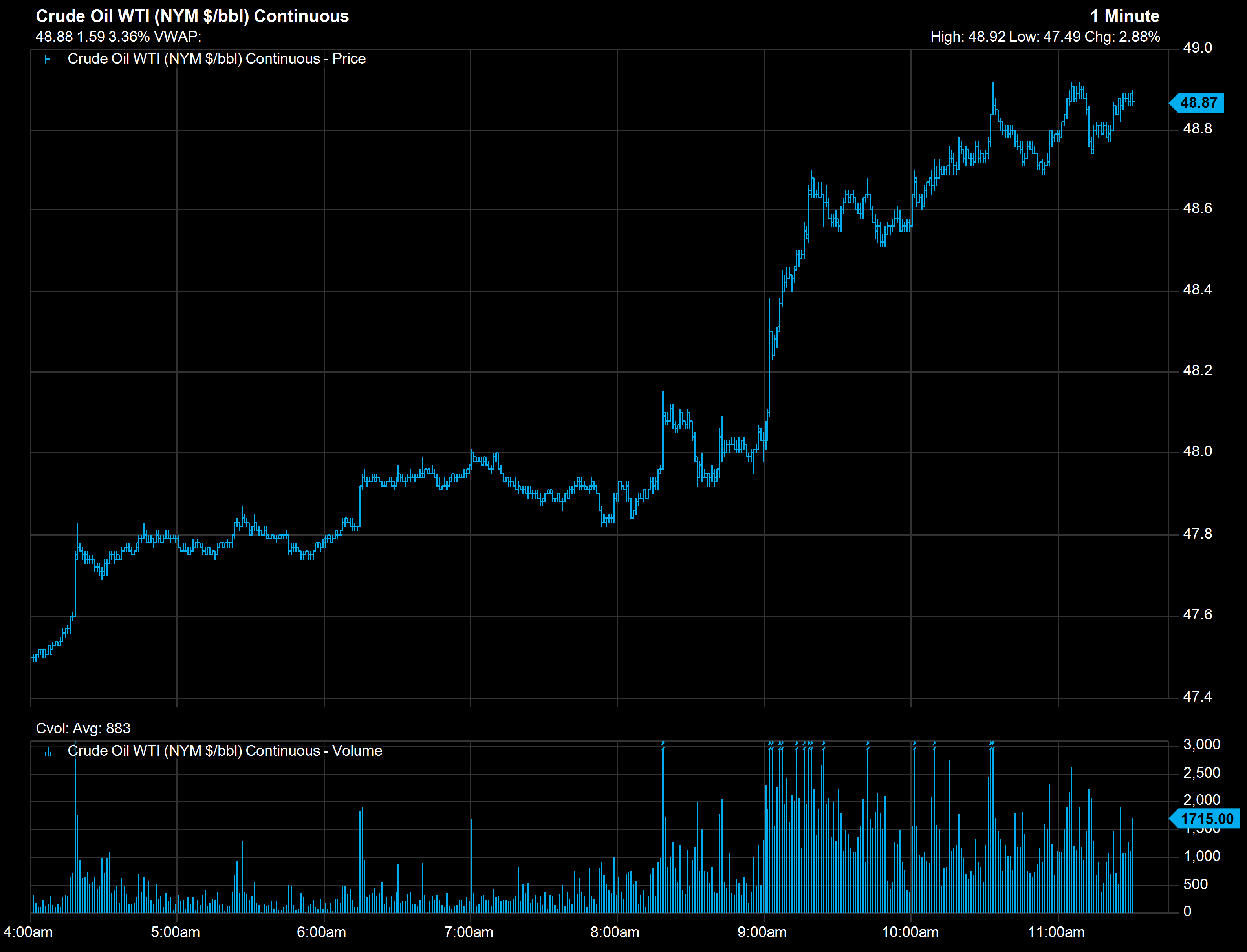
“What we’re seeing here today is really a reversal of the activity we saw in the previous week as oil pipelines were shut down and refineries were shut down,” said Andy Lipow, president of Lipow Oil Associates.
About 3 million barrels a day, or 16 percent of U.S. refining capacity, remained offline or in preliminary restart mode on Monday evening, according to Lipow. That cut about 1.2 million gallons per day of gasoline supply, roughly equal to consumption in California, Oregon and Washington combined.
Refineries were mostly up and running in Corpus Christi, Texas, where Harvey made landfall as a Category 4 hurricane. Plants in Lake Charles, Louisiana, near Harvey’s second landfall last week, were also churning out fuel after briefly reducing activity.
Major pipelines that move fuel from Houston to Dallas, St. Louis, Tulsa and Chicago were back in operation. The critical Colonial Pipeline that runs from Houston through the Southeast and up to New Jersey fixed a partial outage on its diesel line and expected its gasoline line to be running on Tuesday.
But outages lingered at five facilities in the hard-hit Houston area, as well as at four plants just southeast in the Port Arthur-Beaumont, Texas, refining hub. Both areas saw devastating flooding.
Lipow estimates it will be one to two months before operations return to normal at Port Arthur refineries owned by Total and Saudi Aramco-owned Motiva. The Motiva plant is the largest U.S. refinery.
Average U.S. retail gasoline prices, however, would likely peak sometime this week at roughly $2.70 per gallon, he projected.
Traders will have to sort through “a lot of noise” as the market seeks to understand the storm’s impact on crude oil and petroleum product stockpiles, said Michael Cohen, head of energy markets research at Barclays. He noted that the United States is now a major energy products exporter to Latin America and Asia.
“That’s new, and I think that the effects of this hurricane still have not yet been fully understood by the market,” he told CNBC’s “Squawk on the Street” on Tuesday.
Analysts said Hurricane Irma, which strengthened into a Category 5 storm on Tuesday, could wipe out a lot of gasoline demand if it hits Florida on Saturday as expected, and particularly if it travels up the East Coast. Unlike Harvey, Irma is not currently projected to slam Gulf Coast refiners.
Demand for gasoline typically falls between September and October, but consumption dropped by twice as much as business and driving ground to a halt during Hurricanes Rita and Katrina in 2005 and Hurricanes Gustav and Ike in 2008, according to Cohen.
That creates another incentive for a Saudi- and Russian-led group of oil producers to extend their agreement to cut production beyond the first quarter of 2018, said Tamar Essner, director of energy and utilities at Nasdaq Corporate Solutions.
OPEC and other major exporters are keeping 1.8 million barrels a day off the market in a bid to shrink global crude oil stockpiles and end more than three years of oversupply. Weaker demand would typically make it harder to achieve that goal.
Russia and Saudi Arabia have discussed an extension, but have not reached a final agreement, Reuters reported, quoting Russian Energy Minister Alexander Novak.
International benchmark Brent crude was up 97 cents, or 1.9 percent, to $53.31.
The market is expecting OPEC to extend the accord, which should put a floor under oil prices and keep them in a range between about $45 and $55 a barrel, Essner told “Squawk on the Street.”
Cohen, however, believes the market is tighter than some think and warned that oil prices could spike outside of that range, at least temporarily.
News Source: CNBC
Read MoreCNBC/6 September 2017
Oil prices slipped on Wednesday as crude demand remained subdued on the back of refinery closures following Hurricane Harvey which hit the U.S. Gulf coast 10 days ago.
Market focus was also being drawn to Hurricane Irma, a record Category 5 storm, which is barreling towards important shipping lanes in the Caribbean.
Although many refineries and pipelines which were knocked out by Harvey are now in the process of restarting, analysts say it will take some time before the U.S. petroleum industry is back to full crude processing capacity.
As of Tuesday, about 3.8 million barrels of daily refining capacity, or about 20 percent, was shut, though a number of the refineries in that group were in the process of restarting. Several others, including Marathon’s Galveston Bay and Citgo’s Corpus Christi refineries, were running at reduced rates, according to company reports and Reuters estimates.
U.S. West Texas Intermediate (WTI) crude futures were at $48.57 barrel at 0333 GMT, 9 cents, or 0.2 percent, below their last settlement.
In international oil markets, Brent crude futures dipped 19 cents, or 0.4 percent, to $53.19 a barrel.
Meanwhile, Hurricane Irma is heading for the Caribbean islands of Antigua,Barbuda, Anguilla, Montserrat, St. Kitts and Nevis, the Virgin Islands, Puerto Rico, the Dominican Republic, and parts of Cuba.
“With another hurricane threatening to hit the U.S. coast, traders still remain cautious,” ANZ bank said on Wednesday.
Around 250,000 barrels of daily refining capacity in the Dominican Republic and Cuba lies in the currently expected path of Irma, Thomson Reuters Eikon data shows, with several tankers seen on satellite images changing their routes to avoid being caught by the storm.
“Maximum sustained winds are near 185 mph (295 km/h) with higher gusts. Irma is an extremely dangerous Category 5 hurricane … Irma is forecast to remain a powerful Category 4 or 5 hurricane during the next couple of days,” the U.S. National Hurricane Center (NHC) said.
There is another tropical storm on Irma’s heels in the Atlantic, and another one active in the Gulf of Mexico.
News Source: CNBC
Read MoreCNBC/5 September 2017
Toyota chairman says battery breakthroughs key for electric cars from CNBC.
Despite the buzz around electric vehicles, the chairman of Japanese car maker Toyota is skeptical that consumers will embrace such cars immediately, given current limitations in battery technology.
The remarks by Takeshi Uchiyamada, told to CNBC in an exclusive interview, mark a departure from the sentiment of several players in an industry that’s trying to shift quickly to more “green” technology. Volvo, for instance, says that all new models launched from 2019 will be fully electric or hybrids.
Toyota chairman: Skeptical of rapid shift to pure electric vehicles from CNBC.
“I must say up front that we’re not against electric vehicles. But in order for electric vehicles to cover long distances, they currently need to be loaded with a lot of batteries that take a considerable amount of time to charge. There’s also the issue of battery life,” he said.
“But as laws and regulations (that encourage the development of electric vehicles) come into effect in places like China and the U.S., car makers will have no choice but to roll out electric vehicles or risk going out of business,” he said. “Toyota is no exception, but we’re skeptical there would be a rapid shift to pure electric vehicles, given questions over user convenience.”
Parts of NAFTA framework must remain, says Toyota CEO from CNBC.
Uchiyamada said another two or three more technological breakthroughs are needed before vehicles can be fully powered by batteries. Nevertheless, he admitted that some form of electrification is inevitable and that Toyota is already working on developing better batteries to power its cars.
News Source: CNBC
Read MoreCNBC/5 September 2017
CNBC’s Jackie DeAngelis reports the update on oil prices and supplies in the wake of Hurricane Harvey.
Major Texas refineries working to reopen refineries: Here’s where we stand from CNBC.
News Source: CNBC
Read MoreCNBC/5 September 2017
John Kilduff, Again Capital partner, provides his outlook on oil prices as another monster storm threatens the U.S.
Expect more oil price ‘gyrations’ as Hurricane Irma approaches: Expert from CNBC.
News Source: CNBC
Read MoreCNBC/5 September 2017
Multinational energy business Enel has announced that construction has begun on Wayra I, its first wind farm in Peru. In a statement on Monday, Enel said that construction would be via its subsidiary, Enel Green Power Peru.
The first wind turbines are currently being installed at the facility, which will have a total capacity of 132 megawatts once completed. The wind farm is located in the district of Marcona, in the Ica region, and will be Peru’s largest.
“The construction of Enel’s first wind farm in Peru furthers our presence in the country and demonstrates our strong commitment to the Peruvian renewable energy market,” Antonio Cammisecra, head of Enel Green Power, said in a statement.
“Our aim in Peru is to become the leading player in renewable energy, which we consider to be essential for a sustainable development at the local and national level,” he went on to add.
Approximately $165 million will be invested by the Enel Group in the construction of the wind farm, which is expected to enter into operation in the first half of 2018.
The facility will be made up of 42 wind turbines and be able to produce roughly 600 gigawatt hours annually. This will be equivalent to the “annual consumption needs” of more than 480,000 Peruvian homes, and will help to avoid the emission of almost 288,000 tonnes of CO2 every year.
News Source: CNBC
Read MoreThe Asian Infrastructure Investment Bank (AIIB) has announced as much as $210 million in debt financing in order to “tap” the renewable energy potential of Egypt.
In a statement on Tuesday, the Beijing headquartered AIIB said the project would comprise 11 solar power plants with an “aggregate” capacity of 490 megawatts and would help the country to meet its pledges under the Paris Climate Agreement.
“Investing in clean, renewable energy is a big part of our strategy to promote a sustainable and low-carbon future for Asia,” D.J. Pandian, the AIIB’s vice president and chief investment officer, said.
“We are supporting this project because it contributes to Egypt’s renewable energy capacity, and it will help position the country as a regional energy hub, which will have economic benefits for the entire region,” Pandian added.
In terms of its environmental benefits, the AIIB said the solar plants would help avoid over half a million tons of CO2 annually.
Worldwide, the potential of solar is significant. The World Energy Council has said that solar energy has a “big part to play” in cutting future carbon emissions and “ensuring a sustainable energy future.”
News Source: CNBC
Read MoreThe Guardian/5 September 2017
Australia’s Energy Market Operator says the introduction of more renewable energy is helping secure Australia’s electricity grid but that “new approaches” will be needed to avoid blackouts in coming years.
The report comes as the prime minister, Malcolm Turnbull, confirms the government is seeking to extend the life of Australia’s oldest coal power plant, Liddell, and is in talks with owners AGL.
However that idea was shot down almost immediately by the chief executive of AGL, Andy Vesey, who tweeted a response to former PM Tony Abbott assuring him of AGL’s commitment to closing the Liddell power station by 2022.
In its annual Electricity Statement of Opportunities, Aemo found the risk of electricity supply failing to meet demand drops in scenarios where more renewable energy is driven online by state-based renewable energy targets.
The report finds that the highest risk of an undersupply of electricity (USE) occurs in the coming summer of 2017-18 in South Australia and Victoria. But it finds that, as more renewables come online in following years, that risk is progressively lowered.
It also finds that there is a potential for an undersupply of electricity in NSW after 2022, when the coal-fired Liddell power station is slated to close. But the report says: “Aemo’s analysis shows that renewable generation can provide some support to maintain reliability even without firming capability.”
Aemo notes that the introduction of those renewables needs to be carefully managed. “However, if this renewable development was to lead to earlier retirement of existing thermal generation, the risk of USE would increase without additional firming capability,” the report says.
Meanwhile, the report finds there is no material risk of undersupply of electricity in Queensland or Tasmania in the coming 10 years.
The government continues to sit on another Aemo report about Australia’s dispatchable electricity needs, which the minister for the environment and energy, Josh Frydenberg, has said it requires before it can decide whether to implement the Finkel review’s key recommendation of a clean energy target (CET).
Frydenberg has described aspects of the report to News Limited but not yet released it. And in response to the as-yet unreleased report, Turnbull said he is in discussion with AGL to keep Australia’s oldest currently operating coal-fired power station, Liddell, open for for another five years beyond its slated closure date of 2022.
Labor’s Mark Butler criticised the delay in response to the Finkel recommendation of a CET and said it was partly responsible for power rises.
“The investment strike in new electricity generation will continue as long as the prime minister fails to stand up to the extreme right of his party and adopt a well-designed CET,” Butler said. “It’s the prime minister’s weakness and inaction which is driving prices ever higher, growing pollution and increasingly putting the supply of the system at risk.”
It was previously been reported that AGL had refused to keep Liddell open longer because of the carbon risk and the investment required.
But in releasing the first report, the chief executive of Aemo, Audrey Zibelman, said “new approaches” were needed to ensure Australia had enough dispatchable electricity.
“The power system does not have the reserves it once had, and therefore to balance peak summer demand in real time, targeted actions to provide additional firming capability are necessary to reduce heightened risks to supply,” Zibelman said.
Aemo flagged the need for “targeted actions” including 1GW of “strategic reserves” across Victoria and South Australia, as well as innovative demand-response programs to reduce the risk of blackouts.
Zibelman said Aemo was indifferent to which fuels or technology were used.
The report modelled two scenarios for increased renewable energy in the next decade, one where states drove the expansion alone, and one where it was nationally coordinated.
Both scenarios increased the system’s reliability, but the the nationally coordinated scenario drove more renewables, spread them out further, and resulted in a more reliable grid.
News Source: The Guardian
Read More